| From the Same Ant Species, Different Behavior |
| By Louis Jacobson |
click to view |
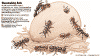
For more than a century, scientists have known that certain
species of ants subsist by raiding other ant colonies and turning their offspring into slaves. But researchers have known relatively little about how these
"slavemaking" ants actually operate in the wild -- until now.
Joan M. Herbers, a biologist at Colorado State University in Fort Collins, and her laboratory colleague Susanne Foitzik have spent the past few years studying ant colonies near Albany, N.Y., and White Sulphur Springs, W.Va. At each location, Herbers and Foitzik observed one slavemaking species -- known as Protomognathus americanus -- as well as the one or two species it enslaved. The enslaved species all belong to the genus
Leptothorax.
What Herbers and Foitzik discovered is that the enslaver ants in West Virginia behaved much differently than the enslaver ants in New York -- even though the ants in both locations belonged to the same species. In turn, the enslaved ants in West Virginia also behaved differently than did those in New York.
Peter Nonacs, a biologist at the University of California at Los Angeles who calls Herbers's work "solid" and "interesting," notes that slavemaking ants interest scientists because they practice several noteworthy behaviors. Ants, like humans, are social animals, with large numbers of individuals alternately cooperating and fighting with one another, Nonacs said. In addition, few species aside from humans take slaves (or, to be precise, domesticate another species for their own benefit, as the ants do).
Herbers's findings also provide new insights into how parasitic species behave and evolve. Parasitic behavior has attracted a great deal of interest recently because it sheds light on many human scourges, from mosquitoes to the influenza virus.
Full
Story
Invader Ants Hurting Ecosystems, Economies
By John Roach
for National Geographic News
When merchant ships embarked from the shores of Brazil and Argentina in the early 1900s to carry coffee and sugar to South Africa, North America, and the Mediterranean, they carried a mischievous stowaway: Linepithema
humile.
The tiny black insect, better known as the Argentine ant, used burgeoning global trade to invade ant communities around the world. Scientists are just now beginning to tally the damage. The reports are grim. Entire native ant populations have disappeared.
Full
Story
From the Antcolony
Message
Board
Question
how do i get a red ant queen without having to dig up nest? will any
red winged ant or one of the workers turn into a queen? if the worker or soldier turns queen how do i make them turn queen? i
cant find any winged ants and i dont want to dig up nest, anyway how
to get queen?
Response
Best advice is to wait till mating season. The winged ants you see in a colony are unmated queens and drones. As for waiting for a worker to become a queen, it will never happen with harvester ants if that is the kind of red ant you are talking about.
Share your ideas,
ask a question or post a reply in the
message
board
|
|
Featured
Websites
Myrm's
Ant Nest
Australian
Ants Online
Courses
The University of
Florida's Research and Education Center at Fort
Lauderdale, Florida will
be offering an undergraduate graduate level ant
course during the summer
of 2004.
Contact
John Warner
ANT LAB
University of Florida
Fort Lauderdale Research
and Education Center
3205 College Avenue
Fort Lauderdale, Florida,
USA 33314
Featured Books
Average Customer Review: 
by Bert Holldobler,
Edward
Osborne Wilson
Usually ships in 24 hours
This is the definitive scientific study of one of
the most diverse animal groups on earth; pretty well everything that
is known about ants is in this massive work. But books do not win Pulitzer
Prizes, as this one did in 1991, for exhaustiveness; besides
being the last word in science, this work is... Read
more or purchase
|
Next Issue |
|
Harvester Ants
Send us Articles, Stories,
Ideas
and Press Releases to
Post
Your News
|
--News--
Frankfurt University researchers, according to a January issue of New
Scientist, found that ants living in bamboo stems in Malaysian rain forests
keep their nests dry by drinking any water that seeps in, then exiting the
nest, urinating, then returning to the nest, repeating the process over and
over until the nest is dry. The researchers found that 2 milliliters of water in a nest caused a colony's ants to scurry back and forth until they
had urinated 3,000 droplets outside.
[New Scientist, 1-6-01]
ANT
FACTS. Ants
are the "super weightlifters". Some ants can carry
objects up to fifty times their weight. And many can haul these objects
long distances and even climb trees with them! If humans could match
this amazing strength, a 100-pound person would be able to pick up a
small car, carry it seven or eight miles on his back, and then climb up
the tallest mountain in the world still carrying the car!
driver
ants of the Savanna consume more animal matter than all of the
larger super predators combined!
|